Blog

7 Best Roofing Time Tracking Software for 2026


TL;DR

Workyard ranks #1 for roofing time tracking with continuous GPS verification, automatic job costing, and offline functionality ($6/user/mo + $50 base). ClockShark works best for small teams needing simple tracking ($40/mo + $9/user). Key features roofing contractors need: continuous GPS (not just clock-in), geofencing, offline mode, job cost tracking, and payroll integration. GPS time tracking eliminates timesheet errors, prevents time theft, and provides accurate labor costs per project, typically reducing payroll discrepancies by 50-80% versus manual timesheets.


Running a roofing business means coordinating crews across multiple job sites, tracking labor costs accurately, and ensuring everyone gets paid fairly. Paper timesheets are error-prone, time-consuming, and nearly impossible to verify.

Time tracking software built for roofing contractors solves these problems. The right system captures precise work hours, verifies employee locations with GPS, tracks labor costs by job, and integrates directly with your payroll system. This eliminates timesheet disputes, prevents time theft, and gives you real-time visibility into how much each roofing project actually costs.

After evaluating the top time tracking solutions used by roofing companies in 2026, we’ve identified seven platforms that handle the unique challenges of managing roofing crews. This guide compares features, pricing, and real-world performance to help you choose the best fit for your business.


Software GPS Tracking Job Costing Multi-Site Works Offline Payroll Sync Best For Pricing
Workyard
Non-stop

Real-time

Automatic

Full

Built-in
Perfect GPS tracking & detailed job costing $6/user/mo
+ $50 base
ClockShark
Clock-in only

Basic

Manual

Limited

Built-in
Small crews who want simple $40/mo
+ $9/user
Hubstaff
Basic

Limited
Tracking field users + office staff Starts at $7/user/mo
Timeero
Breadcrumbs

Basic

Automatic

Full

Built-in
Mileage tracking & seeing where crews went Starts at $5/user/mo
QuickBooks Time
Clock-in only

QB only

Manual

QuickBooks
Already deep into QuickBooks $20/mo
+ $10/user
Connecteam
Basic

Basic

Manual

Limited
All-in-one HR & crew management Starts at $29/mo
(up to 30 users)
TimeCamp
Basic

Project

Manual

Limited
Project tracking & estimating Free tier
Paid: $2.99/users/mo

How We Chose These Roofing Time Tracking Tools

Roofing contractors need more than a basic punch clock. We evaluated each platform based on criteria that directly impact roofing operations:

  • GPS accuracy and reliability: How well the system tracks crew locations throughout the day, even in areas with poor cell signal
  • Job costing capabilities: Ability to allocate labor hours to specific roofing projects and cost codes for accurate project profitability
  • Multi-site support: How effectively the tool handles crews moving between multiple job sites during a single shift
  • Offline functionality: Whether the app continues tracking time when crews work in areas without internet connectivity
  • Payroll integration: How cleanly time data flows into payroll systems like QuickBooks, ADP, and Gusto
  • Mobile usability: How easy the app is for roofing crews to use in the field, including clock-in speed and interface simplicity
  • Compliance features: Built-in tools for break tracking, overtime calculations, and audit trails

#1. Workyard: Most Accurate GPS Time Clock for Roofing Crews

What is Workyard?

Workyard is a GPS-enabled time tracking and workforce management platform built specifically for construction and field service contractors, including roofing companies. Unlike general-purpose time clocks, Workyard captures continuous GPS tracking throughout the workday, creating a verified record of exactly where crews worked and for how long, even when they move between multiple roofing jobs in a single day.

The platform combines time tracking with scheduling, job costing, and compliance tools designed for roofing operations. Crews clock in via mobile app, and their hours automatically tie to specific jobs and cost codes, giving contractors real-time visibility into labor costs per project.

What are Workyard’s key features?

  • Continuous GPS tracking with breadcrumb trails: Records employee locations throughout their shift, not just at clock-in, providing a complete audit trail of where work happened
  • Automatic geofence-based clock-in/out: Crews are automatically clocked in when they arrive at a job site and clocked out when they leave, eliminating forgotten punches
  • Real-time job costing by project and cost code: Labor costs update instantly as hours are logged, allowing contractors to monitor roofing project profitability throughout the day
  • Offline time tracking capability: The app continues tracking time and location even without cell service, syncing data once connectivity returns
  • Integrated scheduling and dispatch: Visual calendar for assigning roofing jobs to crews with automatic notifications when schedules change
  • Break compliance and overtime automation: Automatically calculates overtime based on federal, state, or custom rules and sends break reminders to ensure labor law compliance
  • Direct payroll integration: Exports verified timesheets directly to QuickBooks, ADP, Gusto, Sage, and other payroll systems
  • Photo and note capture: Crews can attach job site photos, receipts, and progress notes directly to time entries

How much does Workyard cost?

  • Free Trial: 14 days, no credit card required
  • Starter Plan: $6/user/month + $50/month base fee
  • Pro Plan: $13/user/month + $50/month base fee

What are the pros and cons of Workyard?

Pros:

  • Industry-leading GPS accuracy specifically designed for roofing and construction crews
  • Offline mode ensures time tracking never stops, even on remote job sites
  • Real-time job costing helps roofing contractors track profitability by project
  • Automatic geofencing reduces timesheet errors and eliminates forgotten clock-outs
  • Seamless integration with major accounting and payroll platforms

Cons:

  • No forever-free version due to advanced GPS and automation features
  • Primarily focused on field service industries like roofing, construction, and property management
  • Higher cost compared to basic time tracking tools that lack GPS verification

What are the use cases for Workyard?

Workyard excels for roofing contractors managing crews across multiple active job sites who need verified labor data for accurate payroll, real-time job costing, and compliance documentation. The platform works particularly well for residential and commercial roofing companies with 5-100 field employees who bill by job or project and need to prove exactly where work occurred.

Roofing businesses using Workyard report significant reductions in payroll errors, faster job costing insights, and better crew accountability. The continuous GPS tracking and automatic clock-in features address the two biggest time tracking challenges in roofing: crews forgetting to clock in and out and disputes over which job site they actually worked at.


#2. ClockShark: Time Tracking for Small Roofing Teams

What is ClockShark?

ClockShark is a cloud-based time tracking and scheduling platform designed for field service businesses, including roofing contractors. The software focuses on making it easy for small to mid-size roofing teams to replace paper timesheets with mobile time tracking, GPS verification, and simple job management.

ClockShark provides basic GPS tracking at clock-in and clock-out, along with scheduling tools, job costing features, and QuickBooks integration. The platform prioritizes ease of use over advanced features, making it accessible for roofing companies new to digital time tracking.

What are ClockShark’s key features?

  • Mobile clock-in/out with GPS verification: Employees clock in via mobile app, capturing GPS location at the time of punch
  • Geofencing alerts: Notifies managers when employees clock in outside designated job site boundaries
  • Job and task assignment: Assign roofing jobs and tasks to specific crew members with time tracking tied to each assignment
  • Basic job costing: Track labor costs by roofing project and generate cost reports
  • Scheduling with crew calendar: Visual calendar for scheduling roofing jobs and crew assignments
  • Timesheet approvals: Managers review and approve employee timesheets before exporting to payroll
  • QuickBooks and payroll integration: Syncs time data with QuickBooks Online, QuickBooks Desktop, and several payroll providers

How much does ClockShark cost?

  • Free Trial: 14 days
  • Standard Plan: $40/month + $9/user/month
  • Pro Plan: $60/month + $11/user/month

What are the pros and cons of ClockShark?

Pros:

  • Straightforward interface that’s easy for roofing crews to learn quickly
  • Dedicated customer support with responsive phone and chat help
  • Kiosk mode allows shared device clock-in for crews without individual smartphones
  • Good balance of features for small roofing companies not needing advanced job costing

Cons:

  • GPS only captures location at clock-in/out, not continuously throughout the shift
  • Limited offline functionality compared to construction-specific platforms
  • Basic reporting that often requires manual Excel work for detailed analysis
  • Pricing can become expensive as roofing crews grow

What are the use cases for ClockShark?

ClockShark works best for small roofing companies (5-20 employees) looking for a simple upgrade from paper timesheets without complex job costing requirements. It’s ideal for residential roofing contractors who primarily need to verify employees showed up at the right job site and worked the hours they claimed, rather than detailed tracking throughout the day.


#3. Hubstaff: Activity Monitoring with Time Tracking

What is Hubstaff?

Hubstaff combines time tracking with productivity monitoring features like screenshot capture, activity levels, and app usage tracking. While not built specifically for roofing contractors, the platform includes GPS tracking and can be adapted for field service use.

Hubstaff’s focus on activity monitoring makes it better suited for roofing companies that also have office staff or want to track both field and administrative time in one system.

What are Hubstaff’s key features?

  • GPS location tracking: Records employee locations during tracked time
  • Geofencing: Sets boundaries around roofing job sites and captures GPS coordinates when work begins
  • Activity level monitoring: Tracks keyboard and mouse activity (primarily useful for office roles)
  • Optional screenshot capture: Takes periodic screenshots of employee screens
  • Timesheets and reporting: Generates timesheet reports by project, employee, or date range
  • Payroll integration: Connects with PayPal, Payoneer, and other payment platforms

How much does Hubstaff cost?

  • Free Plan: Limited to 1 user
  • Starter Plan: $7/user/month (2-user minimum)
  • Grow Plan: $9/user/month
  • Team Plan: $12/user/month
  • Enterprise: Custom pricing

What are the pros and cons of Hubstaff?

Pros:

  • Flexible for tracking both field crews and office staff in one platform
  • Lower per-user cost than construction-specific tools
  • Detailed productivity insights if needed

Cons:

  • Not designed specifically for roofing or construction workflows
  • Activity monitoring features (screenshots, keyboard tracking) unnecessary for field crews
  • GPS tracking less robust than construction-focused platforms
  • Limited job costing capabilities for roofing projects

What are the use cases for Hubstaff?

Hubstaff fits roofing companies with mixed workforces, both field crews and office employees, who want to track everyone’s time in a single system. It’s less ideal for roofing contractors focused primarily on field operations and job costing.


#4. Timeero: Mileage Tracking with GPS Routes

What is Timeero?

Timeero is a time tracking platform that emphasizes GPS breadcrumb trails and mileage tracking. The software captures employees’ driving routes throughout the day, making it particularly useful for roofing contractors who need to reimburse mileage or track vehicle usage between job sites.

Timeero includes geofencing, facial recognition for clock-in verification, and integrations with payroll platforms, but its job costing features are more limited than construction-specific tools.

What are Timeero’s key features?

  • GPS breadcrumb tracking: Records complete driving routes between job sites
  • Automatic mileage calculation: Calculates total miles driven and separates personal vs. business mileage
  • Facial recognition clock-in: Verifies employee identity with facial recognition technology to prevent buddy punching
  • Geofencing: Creates virtual boundaries around roofing job sites
  • Offline time tracking: Continues tracking when mobile signal is unavailable
  • PTO tracking: Manages vacation, sick leave, and time-off requests

How much does Timeero cost?

  • Free Trial: 14 days
  • Basic Plan: $5/user/month (10-user minimum, $50/month base)
  • Pro Plan: $8/user/month (10-user minimum, $80/month base)
  • Premium Plan: $11/user/month (10-user minimum, $110/month base)

What are the pros and cons of Timeero?

Pros:

  • Excellent mileage tracking for roofing crews who travel between multiple sites
  • Facial recognition adds an extra layer of accountability
  • GPS breadcrumb trails provide detailed route verification
  • Competitive pricing for the mileage tracking features

Cons:

  • Limited job costing capabilities compared to construction-focused platforms
  • Minimum 10-user requirement may not work for very small roofing companies
  • Interface less intuitive than competitors built specifically for trades

What are the use cases for Timeero?

Timeero works well for roofing contractors who need detailed mileage tracking for reimbursement purposes or vehicle fleet management. It’s particularly useful for service and repair roofing companies where technicians drive to multiple small jobs per day.


#5. QuickBooks Time: Basic Time Tracking for QuickBooks Users

What is QuickBooks Time?

QuickBooks Time (formerly TSheets) is Intuit’s time tracking solution designed to integrate seamlessly with QuickBooks accounting software. For roofing contractors already using QuickBooks for job costing and invoicing, QuickBooks Time offers a natural extension for capturing employee hours.

The platform includes GPS tracking, mobile clock-in, and scheduling features, though it’s less specialized for roofing operations than construction-specific tools.

What are QuickBooks Time’s key features?

  • Mobile time tracking with GPS: Employees clock in via mobile app with GPS location capture
  • QuickBooks integration: Time data flows directly into QuickBooks for payroll and job costing
  • Job and customer tracking: Assign time entries to specific roofing jobs and customers
  • Geofencing: Set job site boundaries and receive alerts for out-of-area clock-ins
  • Scheduling: Create and assign crew schedules with mobile access
  • Overtime alerts: Notifies managers when employees approach overtime thresholds

How much does QuickBooks Time cost?

  • Free Trial: 30 days
  • Premium Plan: $20/month base fee + $10/user/month
  • Elite Plan: $40/month base fee + $14/user/month

What are the pros and cons of QuickBooks Time?

Pros:

  • Native integration with QuickBooks makes payroll and job costing seamless
  • Familiar interface for roofing contractors already in the QuickBooks ecosystem
  • Reliable GPS tracking and geofencing
  • Strong reporting tied to QuickBooks data

Cons:

  • Less construction-specific features than platforms built for trades
  • GPS only tracks at clock-in, not continuously throughout the shift
  • Higher cost per user than some competitors
  • Best value realized only if already using QuickBooks

What are the use cases for QuickBooks Time?

QuickBooks Time makes sense for roofing contractors already committed to the QuickBooks ecosystem who want time tracking that integrates natively with their accounting workflow. It’s less ideal for roofing companies using other accounting platforms or needing advanced construction features.


#6. Connecteam: All-in-One Workforce Management

What is Connecteam?

Connecteam is an all-in-one employee management platform that combines time tracking, scheduling, communication, and training tools. While not built exclusively for roofing contractors, Connecteam offers GPS time tracking alongside other workforce management features at competitive pricing for small teams.

The platform’s strength is providing multiple HR and operational tools in one system, though this breadth means time tracking features are less specialized than dedicated construction tools.

What are Connecteam’s key features?

  • GPS time clock: Mobile clock-in/out with GPS location verification
  • Geofencing: Restricts clock-in to designated roofing job sites
  • Job and shift scheduling: Visual scheduler with automatic crew notifications
  • Team communication: Built-in chat, updates, and directory
  • Digital forms and checklists: Custom forms for safety inspections, job reports, etc.
  • Basic job costing: Track time by project, though less detailed than construction-specific platforms

How much does Connecteam cost?

  • Free Plan: Up to 10 users with limited features
  • Basic Plan: $29/month for first 30 users, then $0.50/user/month for additional
  • Advanced Plan: $49/month for first 30 users, then $1.50/user/month for additional
  • Expert Plan: $99/month for first 30 users, then $3/user/month for additional

What are the pros and cons of Connecteam?

Pros:

  • Competitive pricing, especially for roofing companies with 10-30 employees
  • All-in-one platform reduces need for multiple software subscriptions
  • Free plan available for very small roofing crews (up to 10 users)
  • User-friendly mobile app with good crew adoption rates

Cons:

  • Time tracking features less specialized than construction-specific platforms
  • Job costing capabilities more basic than dedicated roofing tools
  • GPS tracking doesn’t provide continuous breadcrumb trails
  • Some advanced features require higher-tier plans

What are the use cases for Connecteam?

Connecteam works well for small roofing companies (under 30 employees) looking for an affordable all-in-one solution that combines basic time tracking with scheduling, communication, and documentation. It’s less suitable for roofing contractors needing detailed job costing or continuous GPS verification.


#7. TimeCamp: Automatic Time Tracking for Projects

What is TimeCamp?

TimeCamp is a project-based time tracking platform that automatically tracks time spent on tasks and applications. While originally designed for knowledge workers and agencies, TimeCamp includes basic GPS features and can be adapted for roofing field work.

The platform’s automatic tracking and low cost make it attractive, but its lack of construction-specific features limits its usefulness for roofing contractors managing field crews.

What are TimeCamp’s key features?

  • Automatic time tracking: Tracks time based on computer and mobile app usage
  • Basic GPS tracking: Captures location for mobile time entries
  • Project and task management: Organize time by roofing project and task
  • Invoicing: Generate invoices based on tracked time
  • Reporting: Basic time reports by project, employee, or date range
  • Budget tracking: Monitor project time against budgets

How much does TimeCamp cost?

  • Free Plan: Unlimited users with basic features
  • Basic Plan: $2.99/user/month
  • Pro Plan: $5.99/user/month
  • Enterprise: Custom pricing

What are the pros and cons of TimeCamp?

Pros:

  • Very low cost with free plan available
  • Automatic tracking reduces manual time entry
  • Good for tracking estimating and office time alongside field work
  • Flexible project-based structure

Cons:

  • Not designed for roofing or construction workflows
  • Minimal GPS tracking features compared to field service platforms
  • No geofencing or continuous GPS tracking
  • Limited job costing capabilities for roofing projects
  • Better suited for desk work than field crews

What are the use cases for TimeCamp?

TimeCamp makes sense for roofing companies with significant estimating, sales, or project management work who need to track office time alongside basic field time tracking. It’s not recommended as the primary solution for roofing contractors focused on field crew management and job costing.


Why GPS Time Tracking Matters for Roofing Contractors

GPS time tracking gives roofing contractors verified records of where crews worked and for how long, eliminating guesswork and disputes. Traditional time clocks and paper timesheets rely on employees’ honesty and memory, which leads to three common problems:

  • Prevents off-site clock-ins: Without GPS verification, employees can clock in from anywhere before actually arriving at the job site. GPS-enabled time clocks ensure crew members are physically at the roofing site before their time begins.
  • Eliminates job switching errors: Roofing crews often move between multiple jobs daily. GPS geofencing automatically detects which job site crews are at and allocates hours accordingly, ensuring accurate job costing without manual updates.
  • Captures actual hours worked: Buddy punching and time rounding cost roofing contractors thousands annually. GPS verification confirms each employee’s actual location and work hours, creating an audit trail that protects both contractor and employee.
  • Improves job costing accuracy: GPS time tracking with job site geofencing ensures every hour worked gets assigned to the correct project, giving contractors reliable cost data to inform bidding and pricing decisions.

For roofing companies billing by project or tracking profitability by job, GPS time tracking is the foundation of accurate labor cost management.


What to Look for in Roofing Time Tracking Software

Must-Have Features

  • Continuous GPS tracking: Track employee locations throughout shifts, not just at clock-in. This provides complete records of job site visits, travel time, and work duration.
  • Geofence-based automation: Virtual boundaries around job sites automatically clock employees in and out, eliminating forgotten punches and ensuring correct job allocation.
  • Offline functionality: App must capture time and location data without cell signal, then sync when connectivity returns. Essential for rural sites and metal buildings.
  • Job and cost code tracking: Simple allocation of hours to specific projects and cost codes (installation, repair, tear-off) without complex data entry.
  • Payroll integration: Direct export to QuickBooks, ADP, Gusto with automatic transfer of hours, job codes, and overtime calculations.
  • Compliance tools: Automatic overtime calculation and break reminders based on federal and state rules, plus audit trails for labor dispute protection.
  • Mobile-first design: Fast, intuitive mobile app that crews actually use consistently. Complex interfaces kill adoption.

Implementation Best Practices

  • Pilot first: Test with one crew for 2-4 weeks before company-wide rollout to identify issues.
  • Set geofences correctly: Use 200-300 foot radius for most roofing sites. Not too small (rejects valid clock-ins) or too large (allows off-site punches).
  • Train supervisors: Ensure foremen understand timesheet review, approvals, and troubleshooting before crew rollout.
  • Manage battery drain: GPS tracking uses more battery. Provide vehicle chargers or encourage charging during drives between jobs.

Common Pitfalls to Avoid

  • GPS only at clock-in: Provides minimal verification. Continuous GPS tracking proves where crews actually worked.
  • No offline sync: Apps without offline capability fail in rural areas and metal buildings, creating payroll gaps.
  • Complex clock-in: Multi-step processes kill adoption. Best apps use automatic geofencing or require one-tap clock-in.
  • Hidden pricing: Calculate total cost including GPS tracking, geofencing, and payroll integration, not just base price.
  • General-purpose tools: Office-focused apps lack construction features like offline mode, job costing, and rugged interfaces.

Bottom Line

GPS-enabled time tracking eliminates the errors and disputes that plague paper timesheets. The right platform verifies work locations, automates job site detection, provides accurate job costing, and integrates seamlessly with payroll.

Workyard leads for roofing contractors needing precise GPS tracking and real-time job costing across multiple sites. Smaller operations may prefer ClockShark’s simplicity or Connecteam’s budget-friendly pricing. QuickBooks users benefit from QuickBooks Time’s native integration, while contractors tracking extensive mileage should consider Timeero.

The best solution is one your crews actually use consistently. Test the GPS accuracy, offline functionality, and mobile experience with a pilot crew before committing. Clean timecards and verified labor data matter more than feature lists.


Frequently Asked Questions

What is time tracking software specifically used for in roofing businesses?

Roofing time tracking software captures employee work hours with GPS verification, allocates labor to specific projects and cost codes, and exports timesheets to payroll systems. This eliminates manual timesheet collection, reduces payroll errors, prevents time theft, and provides accurate job costing data for true project profitability analysis.

How does roofing time tracking differ from general construction time tracking?

Roofing contractors typically manage smaller crews working multiple residential sites daily rather than long-term single-location projects. This requires stronger geofencing and automatic job switching as crews move between tear-offs, installations, and repairs throughout the day. Core features remain similar: GPS verification, offline functionality, and job costing.

What features should the best roofing time tracking software include?

Essential features include continuous GPS tracking (not just at clock-in), geofence-based automatic clock-in/out, offline functionality, easy job and cost code switching, break and overtime compliance tools, mobile-first design, and direct integration with QuickBooks, ADP, and Gusto.

Does roofing time tracking software work offline on job sites?

Yes, quality platforms continue capturing time and GPS data without cell service, then automatically sync when connectivity returns. This is essential since roofing sites often have poor signal in rural areas or metal buildings. Workyard, ClockShark, and Timeero all offer offline functionality.

Can time tracking software integrate with QuickBooks for roofing payroll?

Yes, most professional platforms integrate directly with QuickBooks Online, QuickBooks Desktop, or QuickBooks Payroll. These integrations export verified hours, job codes, and cost codes automatically, eliminating manual data entry and reducing payroll errors. QuickBooks Time, Workyard, and ClockShark provide seamless QuickBooks sync.

How accurate is GPS tracking compared to manual timesheets for roofing crews?

GPS tracking eliminates timesheet errors from estimated hours, buddy punching, and misallocated job codes. GPS-verified time clocks capture exact clock-in/out times tied to specific locations, creating an audit trail for both contractor and employee protection. This typically reduces payroll discrepancies by 50-80%.

What is the best time tracking software for small roofing companies?

Connecteam offers a free plan for up to 10 users with limited GPS features. ClockShark provides good value at $40/month plus $9/user. However, Workyard delivers superior ROI through GPS precision and automatic job detection that prevent payroll errors costing small businesses thousands annually.

How does geofencing work for roofing job sites?

Geofencing creates a virtual boundary (typically 200-500 feet radius) around each job site. When employees enter the geofenced area, the app automatically clocks them in and assigns hours to that project. Upon leaving, it clocks them out, eliminating forgotten punches and ensuring accurate job allocation.

Can roofing time tracking software help with labor law compliance?

Yes, modern platforms include automatic overtime calculation based on federal, state, or union rules; break reminders for legally required rest periods; and complete audit trails showing every clock-in, clock-out, and edit with timestamps and GPS verification for labor dispute protection.

What reports can roofing companies generate from time tracking data?

Reports show total hours by employee, project, cost code, date range, and location. Advanced platforms provide labor cost analysis (actual vs. estimated), crew productivity metrics, overtime trends, and job profitability calculations to identify budget overruns and improve future pricing.


About Roofer’s Guild: This article was created in partnership with Roofer’s Guild, a roofing marketing resource and community for professional contractors throughout the United States. Learn more at RoofersGuild.com.

How to Generate Exclusive Roofing Leads in Portland


If you need Portland roofing leads, your first step is creating a company website. Next, you invest in SEO, PPC, and social media marketing. Then, as your brand grows online, leads generate consistently. 

Once your online presence garners enough attention, you no longer need to rely on 3rd-party lead generation services that overcharge you for shared leads.


Exclusive Leads vs. Shared Leads

As a Portland roofer, your goal is to generate exclusive roofing leads. Shared leads are less valuable, and you must purchase them from another company.

Conversely, exclusive leads come from your own platforms and convert at a much higher rate while costing less.


Exclusive Leads

Exclusive leads are prospects that contact your roofing company directly. For example, they find your website after a Google search for roof repair in Portland. 

Or they come across your Google Business Profile when searching for roofer near me. These leads convert rapidly and are more likely to become repeat customers.


Shared Leads

You’ve probably tried to buy Portland roofing leads from one of these big-name lead sellers and have experienced limited ROI, if any.

Unfortunately, these leads are called “shared leads,” meaning the company sells them to multiple roofing companies, which decreases their value and conversion rate. 

Furthermore, the prospects that do convert are less likely to become repeat customers. As a result, shared leads are not a good investment for a roofing company that aims to grow and increase profits.


Creating a Lead Generation Process in Portland, OR

You may be wondering how to get exclusive leads rather than shared ones. It’s pretty simple (though not easy). You need to construct a lead generation process. Roofer’s Guild outlines the exact steps below:


Step 1: Create a Company Website

Your first step is to create a company website, which requires the following:


  • A domain name
  • A hosting provider
  • A website theme (or custom design)
  • On-page content

Depending on your budget, you can hire a professional website designer to craft a custom website for your Portland roofing company. You can use a template theme if you choose to do everything yourself.


Step 2: Search Engine Optimization

SEO is the only legitimate way to generate low-cost leads online. You can utilize Local SEO and organic SEO to achieve your goals. You will need the following:


  • Google Business Profile
  • Optimized company website
  • Optimized website content
  • Links and citations

If you have the budget, consider hiring a roofing SEO company to handle your campaign. However, SEO can be a lot of work, and if you need more time, it’s best to delegate it to an expert.


Step 3: Pay Per Click (Google Ads)

Brand-new Portland roofers must wait 6-12 months to fully benefit from SEO. As a result, you can supplement lead generation with Google Ads. Here’s what you need for a strong PPC strategy:


  • Strong landing pages
  • Proper audience targeting
  • Optimized budget
  • High closing rate

PPC is expensive and, therefore, a poor long-term strategy. We only recommend using Google Ads as a short-term strategy as your SEO matures. If your website is already more than a year old, you won’t even need Google Ads.


Step 4: Social Media Marketing

Don’t believe the hype; most roofing companies get zero leads from social media platforms like Facebook, Instagram, and TikTok. However, these social profiles do influence their more comprehensive online marketing strategy. As a result, it’s important to create profiles on these platforms:


  • Facebook
  • Instagram
  • Linkedin
  • TikTok

Social media profiles allow roofers to link to their websites and share content. As a result, a social media presence can indirectly contribute to lead generation.

Remember, if you rely solely on social media marketing for lead generation, you will be very disappointed, as it is meant to be used in conjunction with other digital assets, such as your website and Google Business Profile.


Step 5: Expand Your Network

As a Portland roofer, you want to join credible institutions like Associated Roofing Contractors of Oregon & S.W. Washington. By becoming a member, they can link to your website via their directory.

Not only do memberships count as a backlink from a credible website, but they can also bring new business to your company.

You can join other directories like HomeAdvisor, Angi, and Houzz, as well as locally driven platforms like the Portland Chamber of Commerce. Feel free to connect with other business professionals in your area.


Types of Portland Roofing Leads

Your company may specialize in a type of roofing, like commercial roofing. In these cases, you want to know where to find flat roofing leads in Portland. On the other hand, you may seek metal roofing, tile, or hotel roofing leads in different scenarios.


Flat Roofing Leads

Flat roofing leads in Portland are excellent because they are typically high-ticket jobs. Create an individual service page titled “Flat Roof Repair Services in Portland, OR on your website to start ranking for related search queries and attracting qualified leads.

You can also target flat roof queries within your Google Ads PPC strategy, though the ROI is less substantial than organic SEO.


Metal Roofing Leads

Metal roofing leads can come from residential and commercial jobs. Try creating a service page called “Metal Roof Repair Services in Portland, OR. It helps conversions if you can publish previous examples of metal roofing jobs.


Tile Roofing Leads

Tile roofing leads typically come from residential jobs. So, if your company specializes in residential roofing, creating a tile roofing service page makes sense. You can also target tile queries in your PPC strategy.


Hotel Roofing Leads

Frequently, commercial roofers look for hotel roofing jobs. You can generate hotel roofing leads by creating a service page titled “Hotel Roof Repair & Installation in Portland, OR.” 


Next Steps for Portland Roofing Companies

Getting more Portland roofing leads is not rocket science. It just takes a little tactful strategy to start increasing consumer interest. For example, create a website, invest in SEO, and expand your professional network. 

Then, in just 12 months, you can start generating a consistent stream of leads. Once you ditch PPC and lead buying, you no longer have to rely on another entity to bring in your leads. Of course, you still need visibility on Google, but organic SEO is highly cost-efficient.

Best of all, your investment keeps paying off as customers leave reviews on your Google Business Profile. As your reviews increase, so does your trust level with consumers. So, ultimately, you rank more frequently in the Local Map 3-Pack and generate a consistent stream of Portland roofing leads.


32 Insane Roofing Statistics You Will Hear About in 2026


Below, Roofer’s Guild outlines 32 intriguing roofing statistics based on our internal data and external research from verified, credible sources. You might be surprised at some of the things that go on in the roofing industry!


Top Roofing Statistics (Quick Chart)

  • There are 102,744 roofing companies in the U.S
  • $41,002 is the average roofing salary
  • The average roof repair costs $1,158
  • The average roof replacement costs $11,500
  • 70% of roofing companies don’t trust marketers
  • Green roofs can recycle up to 60% of rainwater
  • Roofing is forecasted to grow at a 6.6% CAGR by 2032
  • 75% of North American homes have asphalt shingle roofs
  • Cool roofs reduce temperatures by 1.2–3.3°C

Roofing Industry Statistics


Roofing Statistics (Blog Cover)

1) Roofing Businesses

There are 102,744 roofing companies in the United States, an increase of 3.1% from the previous data.

SourceIBIS World


2) Work-Related Fatalities

Roofers die at the fifth-highest rate in work-related construction accidents. At 29.9 deaths per 1,000 full-time equivalent workers, roofers die at almost twice the average rate for all construction workers (15.2).

Source: Electronic Library of Construction Occupational Safety & Health


3) Average Salary

The average salary for a United States roofing contractor is $41,002. The range is typically between $37,013 to $45,923.

Source: Salary.com


4) Market Size

The roofing contractor industry’s market size is $97.9bn, with a 4.0% CAGR since 2019.

Source: IBIS World


5) Workforce Growth

Employment in the roofing industry is expected to grow by 6% over the next decade, about the average for all sectors.

Source: U.S. Bureau of Labor Statistics


6) Roof Repair Cost

The average roof repair in the United States costs $1,158, and most homeowners spend between $393 and $1,939.

Source: HomeAdvisor


7) Roof Replacement Cost

In the United States, replacing a roof costs an average of about $11,500. Most consumers spend between $6,700 and $80,000 for a replacement.

Source: Forbes


8) Roof Lifespan

A typical roof lasts between 25 and 50 years, but the precise number varies significantly by roof type and property type.

For example, a metal roofing system can last up to 75 years, while a rubber roof probably maxes out at 50 years.

Source: Roofer’s Guild


9) NIR Reflectances

Gray-cement concrete tiles achieved a .60 NIR reflectance with coatings colored by NIR-scattering pigments.

Source: Solar Energy Materials and Solar Cells


10) Producer Price Index

In September 2025, the price index for Asphalt Paving and Roofing Materials Manufacturing was 363.407. The all-time low of 91.0000 occurred in February 1987.

Source: Trading Economics


11) Hail Damage By State

Texas leads all U.S. states with 878 annual hail events, while Kansas and Missouri rank second and third, respectively.

Source: Insurance Information Institute


12) Distrust of Marketing Agencies

Nearly 70% of roofing companies lack trust in their existing marketing provider. As a result, it’s important to choose from a list of reputable roofing SEO companies in 2026.

Working with an agency focusing on roofers is a much safer bet when investing in digital promotion.

Source: Roofer’s Guild


13) Salary By State

New Jersey has the highest average annual salary for roofing contractors at $63,533, with North Dakota second.

Source: Zippia


14) Roofing Electrocutions

Approximately 11% of roofing-related deaths are electrocutions.

Source: Electronic Library of Construction Occupational Safety & Health


15) Lead Generation

Traditional lead generation tactics like direct mail can cost $55 dollars per lead, while modern digital techniques like Google Maps optimization can decrease the cost per lead by more than 50%.

Source: Roofer’s Guild


16) Roof Repair Search Term

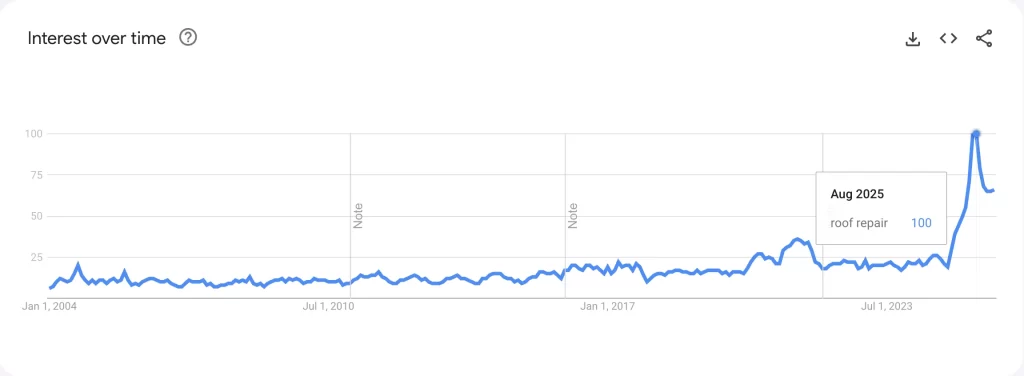
The search term “roof repair” reached the 66th percentile of interest over time in January of 2026. Its highest level of interest ever occurred in August 2025.


Screenshot of Search Term Trend for "Roof Repair" on Google Trends in 2026

Source: Google Trends


17) Women in Roofing

Women make up 5% of the roofing industry’s workforce in 2026. In addition, 11% of roofing machine operators are women.

Source: Fixr


18) Texas Roofing Contractors

There are 8,857 roofing contractors in the State of Texas.

Source: IBIS World


19) Fiberglass Shingles

90% of U.S. asphalt roofs sold are fiberglass shingles.

Source: RoofCalc


20) Residential Roof Square Footage

The average residential roof in the United States is 1,600 square feet.

Source: RoofCalc


21) Tile Roofing Global Industry

Research projects the tile roofing market to reach $41.3 million by 2027.

SourceLinkedIn


22) CAGR Roofing Market Forecast

The USA roofing market is forecasted to grow at a 6.6% CAGR from 2024 to 2032.

Source: Expert Market Research


23) Projected Industry Growth

The roofing industry is projected to increase by 4.3% annually until 2030. The result would be an eight-year consecutive growth rate.

Source: Allied Market Research


24) EPS Insulation Plastic

EPS insulation typically contains about 2% plastic. As a result, roofers should handle the insulation gently, especially when removing it.

Source: Progressive Foam


25) Stormwater Reduction

Between 50 and 60% of rainwater falling onto Pennsylvania green roofs can be recycled back into the atmosphere without entering the stormwater system.

Source: Penn State Extension


26) Asphalt Shingle Market Share

Approximately 75% of North American homes have asphalt shingle roofs, giving the material a 3/4 market share for residential properties.

Source: All Point Construction


27) Global Solar Roofing Market

Projections anticipate that the global solar roofing market will reach 241.6 billion by 2031, partly driven by increasing demand for renewable energy sources.

Source: Cision PR Newswire


28) Florida Roofing Manufacturing Revenue

Florida’s asphalt manufacturing industry is worth $1.5 billion in 2026, growing at a 3.1%. rate since 2020.

Source: IBIS World


29) TPO Membrane Thickness

The vast majority of TPO roof installations utilize 45-mil-thick membranes. The manufacturers’ thickness of these membranes over scrim spans approximately 15 to 19 mils.

Source: Professional Roofing


30) Hail Continues to Damage Roofs

Annual data suggests the U.S. experienced more than 5,373 hailstorms.

As roofing companies know, these storms create roofing jobs quickly and require resources to perform the services as needed.

We expect hailstorms to remain one of the top causes of roofing emergencies in 2026.

Source: Roofer’s Guild


31) Cool Roofs Reduce Energy Demand

Cool roofs can reduce indoor temperatures by 1.2–3.3°C in air-conditioned residential buildings.

Source: Environmental Protection Agency


32) Standing Seam Metal Roof Reflectivity

Standing seam metal roofs can reflect up to 70% of solar radiation while reducing roof surface temperatures by up to 50°F compared to asphalt shingles.

Source: Dependable Roofing


Qualified Roofing Leads in Michigan


The Michigan roofing industry is worth 1.2 billion, with over 1,800 contractors performing services statewide.

My Ann Arbor roofing buddy asked me how to get Michigan roofing leads in such a competitive market.

I said, just like Jim Harbaugh won football games, you have to win the game of digital brand signals.


Roofing Leads Michigan (Blog Cover)

You see, 99% of these Michigan roofers use old strategies – links, content writing, and PPC to fight over a finite pool of local prospects.

Meanwhile, the top 1%, which includes some lead-gen companies and a few select roofers ahead of the curve, are using an entirely different strategy to generate exclusive roofing leads in Michigan.

I told my buddy that by using the strategy of the top 1%, you can leave the gig economy and become a major player in the Michigan roofing industry.


The Michigan Roofing Lead Generation Blueprint

The Michigan roofing lead game is quite simple, despite what you’ve read or what your brother and sister-in-law told you.

How do I know this? My company, Roofer’s Guild, talks to roofing companies daily. We work with them on digital marketing to capture more local prospects in their area.

The ones who succeed all use the same general blueprint, which is, of course, customized to their specific services and locations.


Here is the outline:


Custom Roofing Website

It’s 2025, and websites are boring. Everyone who’s anyone has a website, and a website alone does nothing, right?

The problem is that not having a website is the first step to permanently existing in the gig economy, which leads to bankruptcy.

The Michigan roofers who rake in leads while the others fight for scraps all share a common characteristic – they have a custom roofing website with optimal calls to action.

Your website doesn’t have to win an art contest – it just has to represent your brand and give visitors an easy way to book a service or contact your office.


Google Business Profile

The closest thing you can find to free Michigan roofing leads is generating phone calls and inquiries through a Google Business Profile.

Google Business Profiles are free to claim and optimize and are eligible to rank on Google search results through the Google Map 3-Pack and regular Google Maps results.

The primary ranking factor for your Google Business Profile is location, which means it’s best to have a verified address close to the center of your Michigan city.


Software Check-ins

Google has made many changes to its algorithm in the past several years, most notably the Helpful Content Update, which devalues websites that use traditional SEO content.

Most Michigan roofing websites were built with old-school SEO content, meaning they all took massive hits and lost enormous traffic.

That’s why Roofer’s Guild now offers a software for roofing check-ins that injects your website with original content based on your roofing jobs, wrapped in schema markup and E-E-A-T signals.


GuildMapz Logo

Service-based Keywords

The days of ranking with bullet points are over as Google ranks services on the page level.

To provide TPO roof repair in Detroit, you must create a service page targeting this keyword.

The GuildMapz software then adds extra context to each service page, allowing you to target long-tail keywords like Tamko and HDZ Timberline.


Local Roofing Leads in Michigan

As I was riding in a horse-drawn carriage at Mackinac Island, I suddenly became visibly upset.

Folks were asking, “What’s wrong? ” I simply told them that scam artist lead generation companies are building their brand while hard-working Michigan roofers live in the gig economy.

If Michigan roofing contractors simply followed the lead-gen blueprint, they could acquire exclusive and qualified roofing leads in these locations:


  • Detroit, MI
  • Grand Rapids, MI
  • Warren, MI
  • Sterling Heights, MI
  • Ann Arbor, MI
  • Lansing, MI
  • Flint, MI
  • Dearborn, MI
  • Livonia, MI
  • Westland, MI
  • Troy, MI
  • Farmington Hills, MI
  • Kalamazoo, MI
  • Wyoming, MI
  • Southfield, MI
  • Rochester Hills, MI
  • Taylor, MI
  • Novi, MI
  • Pontiac, MI
  • Royal Oak, MI
  • Kentwood, MI
  • Dearborn Heights, MI
  • Battle Creek, MI
  • Saginaw, MI
  • Allen Park, MI
  • Roseville, MI
  • East Lansing, MI
  • St. Clair Shores, MI
  • Portage, MI
  • Oak Park, MI
  • Muskegon, MI
  • Jackson, MI
  • Garden City, MI
  • Burton, MI
  • Inkster, MI
  • Madison Heights, MI
  • Holland, MI
  • Ypsilanti, MI
  • Lincoln Park, MI
  • Midland, MI
  • Forest Hills, MI
  • Jenison, MI
  • Northview, MI
  • South Monroe, MI
  • Whitmore Lake, MI
  • Beverly Hills, MI
  • Walled Lake, MI
  • Comstock Northwest, MI
  • Grand Beach, MI
  • Grosse Pointe Shores, MI
  • Palmer Woods, MI
  • Eastown, MI
  • Kerrytown, MI
  • Midtown, MI
  • Heritage Hill, MI
  • Burns Park, MI
  • West Village, MI
  • Old Town, MI
  • Depot Town, MI
  • Boston-Edison Historic District, MI


Roofing Lead Variations in Michigan

Another roofing buddy of mine in Dearborn Heights was getting chapped because he was stuck with asphalt shingle roofing leads.

I asked him what his homepage title tag was, and he said “Asphalt Shingle Roofing in Dearborn Heights.”

I chuckled while taking a sip of Bell’s Two Hearted IPA and said, “What did you expect?”


Then I told him how the GuildMapz software can get him the following types of Michigan roofing leads:


Residential Roofing Leads

  • Asphalt Shingle Roofing Leads
  • Metal Roofing Leads
  • Cedar Shake Roofing Leads
  • Architectural Shingle Roofing Leads

Commercial Roofing Leads

  • EPDM Roofing Leads
  • TPO Roofing Leads
  • Modified Bitumen Roofing Leads
  • Built-Up Roofing (BUR) Leads

Service-Specific Roofing Leads

  • Tear-Off and Roof Replacement Leads
  • Storm Damage Roofing Leads
  • New Roof Installation Leads
  • Flat Roof Resealing Leads
  • Emergency Leak Repair Leads


Moving Forward with Roofing Leads in Michigan

The roofing lead generation industry can be frustrating for contractors who simply want to acquire more qualified prospects without jumping through hoops.

There is a great opportunity to capture new roofing jobs in the Wolverine State as long as you understand the blueprint.

Google and ChatGPT look for digital brands instead of roofers living job-to-job, based on a 3rd party lead provider.

You can become a major player in Michigan roofing leads using the tactics and software outlined above.


Exclusive Roofing Leads in Ohio


If your company could generate 85 exclusive roofing leads in Ohio without paying for ads, would you take advantage of it?

That’s the opportunity facing Ohio-based roofers who invest in brand signal generation through apps like GuildMapZ from Roofer’s Guild.

Google changed the entire roofing lead generation industry in August 2022 with the release of the Helpful Content Update.


Roofing Leads Ohio (Blog Cover)

Since then, they have expanded and reinforced their content standards with subsequent updates, including the March 2024 Core Update.

Today, nearly 97% of roofing web content generates zero traffic.

Your Ohio roofing company website was almost certainly decimated by Google updates over the past few years, which is why you found this article.


If your website were ranking for terms like roof repair columbus you wouldn’t be here.


Exclusive Ohio Roofing Lead Generation

Using Roofer’s Guild strategy and software, Ohio roofers can generate exclusive roofing leads.

For your company to acquire the highest number of roofing prospects in Ohio, you have to complete each step of the process.

Below, I will outline the specific elements of successful roofing lead generation for Ohio roofing contractors.


Custom Website

Websites without industry-specific calls to action are lead deterrants and represent a sunk business cost.

At Roofer’s Guild, we understand that Ohio roofers need a custom website optimized for regional conversions.

Roofing website designs are unique and require a specific protocol proven to drive lead generation and conversion.


Google Business Profile

When Ohio roofing contractors call me asking for my services, I tell them they need a Google Business Profile to qualify.

Yes, we can help you create your Google Business Profile, but you should already have claimed it if you are serious about lead generation.

Your Google Business Profile makes you eligible to get Google reviews and rank within the Map 3-Pack for specific queries.

We optimize and manage your listing before powering it with our GuildMapZ software to help you rank for thousands of keywords on the Map 3-Pack.


Software Check-ins

Our software, GuildMapZ, allows Ohio roofers to publish check-ins after completing roofing jobs in the state of Ohio.

The check-in collects your location data, job photos, and a unique job description.

From there, the software tags the check-in to your optimized website page for optimal rankings.


GuildMapz Logo

Service Keywords

Roofing marketing agencies that ask Ohio contractors to pick 10 keywords are harming both the roofing and marketing industries simultaneously.

The goal is to rank for every single roofing keyword related to your total addressable market (TAM), which is any consumer you can service with roofing services.

We build our service pages using a content map and then install GuildMapZ to capture the long-tail variations for each service and city.


Types of Ohio Roofing Leads

As I enjoyed a beautiful day at the Franklin Park Conservatory and Botanical Gardens, I started thinking about my close Ohio roofer friend who got screwed by the marketing industry.

He wanted roof coating leads and commercial roofing leads in Ohio, but the 20-something marketer sold him a one-page website with paid backlinks.

My friend ended up ranking for exactly zero keywords, not even his brand name.


Google was so appalled by the effort that its one-page never even got indexed on their search engine.

That’s when I told him about GuildMapZ, which shows Google and other search engines the work he has done, including projects with roof coatings and commercial roofing jobs.


GuildMapZ helped him get these kinds of roofing leads:


  • Commercial Roofing Leads 
  • Roof Coating Leads
  • Metal Roofing Leads
  • Silicone Roofing Leads
  • Acrylic Roofing Leads
  • Residential Roofing Leads
  • Hail Damage Leads
  • And More!


Local Ohio Roofing Leads

Roofing websites should focus on a 25-mile radius within Ohio rather than targeting the entire state.

While GuildMapZ is capable of capturing keyword rankings throughout the entire state, Google will always prioritize websites that focus on areas that meet the user’s intent.


For example, a homeowner in Columbus, Ohio, is not going to be interested in Cleveland roofing services.

Google knows this, and you have to know it too.


GuildMapZ can help you capture roofing leads in the following cities:


  • Columbus, OH
  • Cleveland, OH
  • Cincinnati, OH
  • Toledo, OH
  • Akron, OH
  • Dayton, OH
  • Parma, OH
  • Canton, OH
  • Lorain, OH
  • Hamilton, OH
  • Youngstown, OH
  • Springfield, OH
  • Kettering, OH
  • Elyria, OH
  • Middletown, OH
  • Newark, OH
  • Cuyahoga Falls, OH
  • Dublin, OH
  • Lakewood, OH
  • Mansfield, OH
  • Beavercreek, OH
  • Delaware, OH
  • Euclid, OH
  • Mentor, OH
  • Strongsville, OH
  • Fairfield, OH
  • Grove City, OH
  • Huber Heights, OH
  • Cleveland Heights, OH
  • Austintown, OH
  • Bridgetown, OH
  • Amelia, OH
  • Bainbridge, OH
  • Beckett Ridge, OH
  • Blacklick Estates, OH
  • Apple Valley, OH
  • Chesterland, OH
  • Champion Heights, OH
  • Cherry Grove, OH
  • Calcutta, OH


Sign up for Roofing Leads in Ohio

Roofing lead generation can be a sketchy industry with many vendors selling shared leads or overpromising about projected lead totals.

Still, Ohio is a great state for roofing work, and branded companies can capture leads online through a series of strategies and software tools.

Google wants to view your company as a brand, not just a contractor in the gig economy.


They really don’t want you buying leads from big-time lead sellers because there’s no way for them to gain trust in your business.

When you sign up for Ohio roofing leads using Roofer’s Guild, you can build a long-term, sustainable stream of exclusive and high-quality prospects to propel your business to a powerhouse in The Buckeye State.


Georgia Roofing Marketing Services


While I wouldn’t refer to myself as the Hank Aaron of roofing marketing, I have probably hit the most marketing home runs in the state of Georgia.

Whether it’s helping local companies secure Atlanta roofing leads or engineering software to empower nearby roofers to rank #1 for “roofer in Atlanta” on Google, Bing, and ChatGPT.

Roofer’s Guild is not a typical advertising agency in which a bunch of arrogant college graduates browbeat local contractors into intellectual submission.


Georgia Roofing Marketing

Instead, we are champions of the roofing industry and the community at large.

That’s why when I was on a scenic stroll through Rock City Gardens, I became overwhelmed with anger at the thought of how many Georgia-based roofers are being taken advantage of with their marketing services.

Our Georgia roofing marketing services ensure that roofing companies get the visibility they need to thrive.


Georgia Roofers Thrive With Software-Driven Digital Marketing

Roofing competition is fierce, and homeowners have more choices than ever. Suppose your roofing company isn’t showing up on Google when people search for services in your area. In that case, you’re missing out on valuable business.

We help roofers establish a strong digital presence by improving local SEO, optimizing Google Business Profiles, and leveraging customer reviews to build trust. Our approach turns searches into phone calls and website visits into booked jobs.


Roofer’s Guild provides marketing services in these Georgia cities:


  • Atlanta, GA
  • Savannah, GA
  • South Fulton, GA
  • Sandy Springs, GA
  • Roswell, GA
  • Warner Robins, GA
  • Johns Creek, GA
  • Alpharetta, GA
  • Marietta, GA
  • Valdosta, GA
  • And More!

Georgia Roofing Marketing Software That Delivers Results

We don’t just market your business—we give you an edge with powerful software designed specifically for roofers:


  • Automated Local SEO – Our system optimizes your website to rank for key roofing searches in Georgia cities.
  • Job Check-Ins with Geo-Tagging – Show potential customers your completed work with real-time location updates.
  • Review Management – Get more customer reviews and display them strategically to build credibility.
  • Social Media Automation – Turn job site updates into compelling social content that drives engagement.

GuildMapz Logo


Digital Marketing Essentials for Georgia Roofing Contractors

I always tell my Georgia roofer friends that marketing is not just one thing. It is a combination of efforts and touchpoints that culminate in a cohesive company image.

At Roofer’s Guild, we’ve done our best to simplify this by combining all these touchpoints into our software.

However, for the software to work properly, it still requires roofers to have the following:


Business Website

You cannot market your company with a business website because that’s where you showcase all your roofing jobs and outline your services and service areas.

You don’t have to spend a fortune to create a website, but it must be indexable by search engines and showcase original photos of your work.


Google Business Profile

Every Georgia roofing company needs a Google Business Profile. These are 100% free to create, and you can create one here.

A Google Business Profile makes your company eligible to appear within Google Maps, which allows potential customers to see your profile when searching for keyword terms.

Furthermore, Google Business Profiles showcase your Google reviews, which helps your company establish a favorable reputation and convert more prospects.


Branding

Successful marketing campaigns are built on brands, which means not only a logo and slogan but also a demonstration of expertise and authority.

In the digital marketing world, Google has an acronym for this called E-E-A-T, which means experience, expertise, authority, and trust.

You must show Google and its users that your company is legitimate and can solve their roofing problems. Our services help you achieve this goal.


Why Georgia Roofers Choose Our Company

Roofing in Georgia presents unique challenges, from severe thunderstorms to hot summers that wear down materials.

We understand the market and tailor our marketing strategies to meet the needs of roofers in Atlanta, Augusta, Macon, and beyond.

At Roofer’s Guild, we’re more than a service provider—your growth partner. Let’s put your roofing business on the map and get you more customers today.


Florida Roofing Marketing Services


Florida roofing marketing is a separate discipline from the rest of the country. It is a state famous for beaches, amusement parks, and unpredictable weather, and its marketing strategies require alignment with its unique characteristics.

Just like Tim Tebow left his mark on Florida football, your roofing business needs to make a lasting impression in a competitive market. From the infamous sidewalks of St. Augustine to the modern skyline of Miami, property owners across the state need reliable roofing services.

At Roofer’s Guild, we provide digital-first Florida roofing marketing concepts and tools to help your business shine and win more customers.


Florida Roofing Marketing

Florida Roofing Companies Can Succeed With Marketing

During my brisk walk on the Tampa Riverwalk, I had an extremely upsetting thought: Most roofing marketing agencies are mishandling Florida roofers’ online campaigns.

Instead of empowering Florida roofing companies to create their own sustainable lead generation flow using SEO and brand building, they are forcing them to rely on 3rd party conglomerates that take home a share of profits.

There’s a better way for local roofing contractors in Florida to succeed.


Roofer’s Guild offers marketing services in various Florida cities, including:

  • Jacksonville, FL
  • Miami, FL
  • Tampa, FL
  • Orlando, FL
  • St. Petersburg, FL
  • Port St. Lucie, FL
  • Cape Coral, FL
  • Hialeah, FL
  • Tallahassee, FL
  • Fort Lauderdale, FL
  • Pembroke Pines, FL
  • Hollywood, FL
  • Gainesville, FL
  • Miramar, FL
  • Palm Bay, FL
  • Coral Springs, FL
  • Lehigh Acres, FL
  • West Palm Beach, FL
  • Lakeland, FL
  • Spring Hill, FL
  • Clearwater, FL
  • Brandon, FL
  • Pompano Beach, FL
  • Miami Gardens, FL
  • Davie, FL

Get More Roofing Leads in Florida

You don’t just want clicks—you want qualified Florida roofing leads. When a homeowner searches for a roofer in their city, your business should be the first name they see.

We make that happen by optimizing your online presence for local searches, ensuring you show up on Google Maps, and building trust through customer reviews and engaging content.

Our strategies are built for real-world results, helping you book more jobs and grow your reputation.


Florida Roofing Marketing Software That Works

We go beyond basic marketing with powerful software called GuildMapZ, designed specifically for roofers, giving you an edge over the competition:


  • Automated Local SEO – Our system keeps your service pages optimized for Florida’s top roofing searches.
  • Job Check-Ins with Geo-Tagging – Showcase completed projects in real-time to strengthen your online presence.
  • Review Management – Get more positive reviews and display them across multiple platforms for credibility.
  • Social Media Connection – Turn real job updates into engaging content that builds trust and drives leads.

GuildMapz Logo


Roofing Marketing Servies in Florida

The scope of marketing spans different areas, but our company focuses on digital solutions. However, it’s important to understand that digital marketing requires a modern approach that incorporates new concepts like AI and brand building to satisfy Google’s standards and user intent.

Take a look at some of our marketing services:


Search Marketing

Search marketing, which folks commonly call Florida roofing SEO, is not the most popular these days because agencies don’t let folks know what it really means.

For example, agencies tell Floridians that “SEO” is just putting up a website, but that’s not true.

Google looks for brand-building metrics, such as the number of reviews you have and the number of times your company is mentioned on other websites.

At Roofer’s Guild, we understand how to properly implement SEO in the Sunshine State.


AI Marketing

In search results, AI marketing is relatively new since Google now shows AI Overivews (AIO).

This is a new frontier in digital marketing for Florida-based roofing contractors because Google shows them above normal results.

The best way to get mentored in these AI answers is to build a brand everywhere, including Google, Facebook, Instagram, and offline.

The more your brand name is known, the more likely the AI models will get trained by data that knows about your brand.


Local Marketing

Make no mistake, local marketing is different in Florida than anywhere else, and that means you must appear on Google Maps.

Showing up on Google Maps involves claiming a Google Business Profile and optimizing it for local queries like ” Florida roofer near me.”

You might wonder who gets to show up on Maps for these results, but it all comes down to building a local brand and a strong online presence.

You must also prioritize selecting an address in the centroid of your main city and accumulate as many legitimate customer reviews as possible.


Why Florida Roofers Love Roofer’s Guild

Florida roofing isn’t like roofing anywhere else. Between hurricane damage, heat exposure, and strict state regulations, you need a marketing team that understands the industry inside and out.

Whether you’re working in Orlando, Tampa, or Fort Lauderdale, we create marketing strategies that fit your business, customers, and local competition.

At Roofer’s Guild, we don’t just offer services—we help you build a trusted name among homeowners. Let’s connect and take your business to the next level.


Roofing Marketing: 19 Techniques for Roofers (w/2025 Guide)


Roofing marketing is one of the most essential components of a successful business in 2025. Still, the question of How to market a roofing company yields a complicated variety of answers.

Roofer’s Guild has dedicated its life to the cause. Based on our decade-plus of marketing experience, we help roofing contractors find the best methods to promote their services for long-term success.


Roofing Marketing Resource

What is Roofing Marketing?

Roofing marketing is the venture or commerce of vending and promoting roofing services and products through publicity and advertising.

Marketing can materialize in various forms, including online endorsement and traditional print advertising.


Roofing Marketing Stats

Frequently Asked Questions About Marketing for Roofers

How Do You Market a Roofing Company?

You market a roofing company with various promotion forms, including search engine optimization, Google and Facebook advertising, and content marketing.

You can also utilize traditional methods like door knocking, billboard placements, newspaper ads, and radio / TV spots.


What are Roofing Leads?

Roofing leads are potential consumers who initiate inquiries or interest in a roofing service or company.

A lead may represent a consumer at varying points in a sales funnel, from someone ready to purchase immediately to someone seeking introductory information about a company, service, or material.


What About Commercial Roofing Marketing?

Commercial roofers sometimes question whether marketing techniques apply only to residential campaigns. The answer is no.

While you must alter campaign elements to target retail consumers specifically, the framework remains unchanged.

The same methods (SEO, PPC, SMM) work for commercial roofing companies. Most importantly, research your audience and understand who you’re targeting for services.


19 Marketing Tips for Roofing Companies

Roofer’s Guild will separate modern marketing techniques (digital marketing specifically) from traditional marketing ventures for organizational purposes.

Modern marketing can be fast-paced and intimidating to roofing contractors across the world.

Still, the possibilities introduced by online promotion are limitless and provide roofers with various channels to grow their business. Let’s review them.


1) Search Engine Optimization

SEO for roofers provides the highest ROI of any competing marketing technique. However, it comes with caveats that sully its reputation.

First, SEO is much like the Wild West because regulations are sparse, and con artists dilute the industry.

Since Google conceals its ranking algorithm, some SEO elements are nothing more than an educated guess. Choosing the right SEO agency to implement your SEO strategy is critical to long-term success.


Organic SEO

SEO produces the lowest cost per lead but takes time to implement and develop.


2) Email Marketing

Roofing email marketing remains an effective strategy for internet promotion. With email blasts, there is a right and wrong way to execute the method.

For instance, blindly sending out email blasts to every one of your subscribers is ineffective and provides negative ROI.

In contrast, personalized and custom emails (based on the subscriber’s behaviors) regularly boost sales for roofing companies throughout the U.S.

Email marketing for roofers is a great strategy to earn repeat business from former customers.

In addition, email campaigns can close new customers who previously entered your sales funnel.


Email Blast Tool

Email marketing keeps leads warm and increases the lifetime value of customers.


3) Content Marketing

Think of content as a currency for roofing lead generation. More prospects materialize as more users interact with your content, whether blog posts, YouTube videos, or even podcasts.

Marketing your content requires two primary steps.


First, content creation can be challenging for roofers with limited experience on-camera or behind a computer.

The second is content distribution, which demands an understanding of syndication platforms, including various social media channels.


Google’s algorithm update, “The Helpful Content Update,” cleans up search results laden with low-quality spam copy and replaces it with content that demonstrates clear expertise.


Content Lifecycle

Helpful roofing content demonstrates expertise, experience, authoritativeness, and trustworthiness.


4) Social Media Marketing

Social media marketing for roofing companies is often left unattended despite its documented benefits for properly implementing brands.

Facebook and YouTube, in particular, are goldmines for roofers.

We’ve witnessed countless examples of outgoing roofing owners generating engagement through videos distributed through social media platforms.

Most roofing professionals have sales experience, which can easily translate to video with trial and error. Furthermore, video content works for most social media.


Roofing Social Media Page

A social media presence helps roofers maintain their exposure to potential customers.


5) Pay Per Click (PPC) / Online Advertising

Roofing companies looking for quick responses often invest marketing dollars into paid advertising through platforms like Google, Facebook, and other digital media.

In particular, Google Ads and Facebook Ads have grown in popularity over the past decade.

Though PPC is a worthwhile venture for most roofers, it’s ineffective for long-term branding.

Consumers attribute your service to a third-party platform (like Google) rather than your company, limiting the likelihood of repeat business.

In contrast to SEO, which takes months to impact your bottom line, PPC ads can yield immediate leads if you target the right keywords.

By the same token, PPC ads also drain your budget quickly.


Roofing PPC Ads

Paid Ads can supplement your long-term marketing efforts initially as you wait for tactics like SEO to mature and deliver ROI.


Traditional Marketing for Old-School Roofers

Though digital marketing is now front and center for roofing marketing campaigns, old-school methods are still useful in many cases.

Traditionalists may favor old-school techniques over contemporary tactics, but combining traditional and modern marketing practices can produce spectacular results.

Let’s review some of the more conventional roofer marketing methods below.


6) Billboard Promotion

Promoting your roofing company on a billboard can generate interest, particularly in high-traffic areas. Its impact can occur quickly, but tracking precise results is a significant challenge.

Billboard advertising works on consumers’ psyche, often unconsciously creating ambiguity regarding its ROI.

Additionally, billboards are very costly and can run roofers up to $15,000 in expenses.

Billboard promotion may seem obsolete, but its impact is still valuable.

However, expect to pay substantially to advertise your roofing company using this method.


Roofing Billboard Example

Billboards impact the consumers’ psyche in ways that digital marketing does not.


7) Print Advertising

Print and newspaper ads, particularly, remain useful for reaching local consumers. Unlike billboards, newspaper ads are affordable and flexible with changes.

The primary downside to print advertising is the increasingly limited amount of viewers.

Most newspaper subscribers have migrated to online versions of the news, contributing to the rise of digital marketing for roofers.

Print advertising represents a more affordable alternative to billboards. However, impressions generated from magazines, newspapers, and other print materials have increasingly decreased in the past decade.


Roofing Print Magazine

Older customers still value print advertising in their buying decisions despite the landscape shifting significantly toward digital.


8) Radio / Television Spots

There was a time when roofers relied heavily on radio and TV spots to gain notoriety within their local community.

For example, towns hit with hail storms often heard roofing company ads on their local radio stations, which helped maximize lead generation for roofers.

Like with print ads, a large share of radio and TV platforms have been replaced with podcasts and streaming services, emphasizing the importance of digital marketing ventures.


Roof TV Spot

TV spots are now primarily reserved for the largest brands as newcomers shift to digital exposure through podcasts and YouTube.


9) Door Knocking

Door knocking remains one of roofing contractors’ most effective marketing techniques. Door knocking is simply a numbers game with an even greater closing rate than telemarketing.

Despite its upside, door-to-door sales present a set of unique challenges.

Perhaps the most poignant is that it’s too time-consuming.

Roofers often hire canvassers to scout neighborhoods while focusing on other business aspects.


10) Direct Mail

Think of direct mail as traditional email marketing that, when properly implemented, still works.

Some older clients respond to conventional mail more favorably than email and may leave promotional materials around their house or apartment for later viewing (unlike emails).

Measuring open rates and other micro-targeted metrics is impossible with direct mail.

Furthermore, response rates are typically lower than email marketing.


Roofing Company Postcard

Direct mail can still be an effective promotional tool, particularly for the older demographic within your customer base.


Roofing Marketing Ideas To Consider in 2025

Successful roofing companies all utilize some form of marketing. Finding unique ways to increase visibility can be competitive and challenging.

Roofer’s Guild works with various contractors across the United States to identify innovative measures for lead generation.

Let’s take a look at some of the most effective roofing marketing ideas your company can invest in right now:


11) AI Marketing

Since the launch of ChatGPT, AI has emerged as part of every marketing strategy. Google has now adopted AI as part of its search engine with AI Overviews.

While the speed at which AI is advancing can overwhelm us as roofing professionals, it’s important to view this new development as a marketing opportunity.

Using innovative marketing techniques like brand mention optimization, local roofers can increase their chances of appearing in AI-generated answers, which are increasingly influential on consumer behavior.

Many of your foundational digital marketing tasks will translate into AI marketing, but you must also embrace the new technology to maximize results.


12) Custom Website Design

Most roofers have a website, but how many of them are custom? With prominent website builders like Wix, Weebly, and Squarespace, custom websites stand out among the crowd.

A custom WordPress website can appeal to a greater cross-section of users and please Google’s algorithm in areas where template-based designs fall short.

Most companies don’t understand how much traffic they lose by using a template website instead of a custom design.

Multi-page websites perform much better on search results and conversions.


Custom Commercial Roofing Website

Roofing websites are essential to marketing success.


13) Social Proof

Generating traffic is the first step, but converting it into a sales funnel entry requires additional measures. Users repeatedly cite social proof as one of the essential factors in informing a purchase decision.

Showcasing positive reviews or jobsite check-ins can help humanize your roofing company and instill the necessary trust in future clients as they make a final decision.

Google’s Helpful Content Update has placed a more significant premium on expertise, experience, authoritativeness, and trustworthiness (E-E-A-T), which social proof embodies.


Social Proof for Roofers

Showcasing recent jobs is essential to building trust with website visitors.


14) CRM Software

Organization is critical to every aspect of your roofing company, including marketing. Clients improve your reputation through online endorsements as you close more sales and perform efficient jobs.

A CRM that requests reviews on Google, Facebook, and other platforms helps your marketing efforts and expands your reach.


CRM Summary

Roofing Advertising Ideas To Ponder in 2025

There’s a saying in business that you have to spend money to make money.

Since its inception, advertising has been part of American culture, and roofing companies with substantial profit margins almost certainly engage in some form of advertising.

Intelligently allocating advertising resources to the proper channels often separates top-rated roofing businesses from their inferior competitors.

Let’s spitball some ideas.


15) Hail Storm PPC

Some contractors might cringe at the thought of targeting towns recently hit by significant hailstorms but believe it or not, hail storm PPC is one of the most popular advertising ideas for roofers.

Sometimes, local roofers can strike gold when their primary service area gets hit with hail.

You may already have a local reputation, and investing in timely PPC ads can bring you to the next level.

If you choose this route, ensure you work only with a qualified and competent PPC campaign manager.


Hail Storm PPC Screenshot

Hailstorms are often a goldmine for roofing companies willing to advertise to affected areas.


16) Ad Retargeting

If you’ve browsed the web and noticed similar or identical ads on multiple websites, an advertiser is retargeting your IP address. Roofers can utilize the same strategy for potential customers.

Facebook and Google Ads support retargeting mechanisms that allow you to get in front of qualified prospects while browsing the internet.

Repeated visibility often makes a difference in large ticket items like roofing services. 

Consumers are more willing to pay as they grow more comfortable with your brand.


Retargeting Example

Ad Retargeting works on warm leads as opposed to initial advertising, which targets cold leads.


17) Industry Influencers

Not every roofer is an email or social media marketing expert or has a large enough audience to warrant considerable ROI.

Rest assured that people within your industry have a larger audience than you, and many are willing to promote your services on their platforms.

Whether someone has a popular roofing YouTube channel or a massive Instagram following, you can pay them to plug your company.

Of course, most social platforms now have rules that require the influencer to tag the post as #sponsored so that users know about money changing hands.


Roofing Influencers

Source: YouTube


Networking with social media influencers and podcasters can create marketing opportunities.


Bonus Marketing Techniques for Roofers

Most blogs are going to cover the same types of marketing techniques for roofers.

While they may put an innovative spin on some of their suggestions, they aren’t going to tell you anything you haven’t already considered.

Roofer’s Guild will present ideas you probably never even thought about for the following two strategies.

Though these methods are only viable if you properly execute other parts of your marketing campaign, they can take you to the next level if properly executed.


18) Neuromarketing

Neuromarketing targets neural signals to gather customer insights and projects their behaviors, responses, and other activities.

There is some controversy surrounding the concept since it can manipulate consumers without them realizing their motivations.

In other cases, however, neuromarketing can increase brand appeal without breaking ethical boundaries.

For example, designing your logo with red, white, and blue can activate patriotic responses from potential customers.


19) Affiliate Marketing

Selling services is not the only way for roofing companies to make money. Did you know you can make money as a referral partner for other companies?

Let’s say your website ranks for a phrase like best vinyl siding cleaners.

As an authoritative company that does roofing and siding services, you do have a chance to rank for terms like these.

You can link out to product pages for the best cleaning products in exchange for a commission on each sale.


Final Thoughts

Marketing your business is a challenge. While more options exist, choosing the right strategies takes understanding the roofing industry and your business’s growth trajectory.

Some methods work better than others, depending on your personality, region, and experience.

Still, it helps to understand all the options available for your business.

If your competitors use a specific technique, you should research what they are doing.

Contact us at Roofer’s Guild if you need help optimizing your roofing company marketing strategy.


Connecticut Roofing Marketing Services


I’m not saying I’m the roofing industry equivalent of Rip Hamilton in 1999, but I know a thing or two about Connecticut roofing marketing.

How so? I’ve helped Connecticut roofers dominate online search results and generate qualified roofing leads in CT.

At Roofer’s Guild, marketing is our passion, which is why the thought of some high-falutin marketer ripping off hard-working Connecticut contractors makes my blood boil.


Connecticut Roofing Marketing

While I was spending a Saturday afternoon at the iconic Mark Twain House, I suddenly had a thought that disgusted my very essence: CT roofers are getting ripped off by bad marketing practices.

Connecticut is built on a foundation of history, innovation, and resilience. The same can be said for the roofing companies that keep homes and businesses across the state safe from the elements.

Our Connecticut Roofing Marketing services promote your company’s visibility with cutting-edge digital strategies designed for the modern roofer.


Connecticut Roofing Business’s Stand Out With Marketing

You work hard on every roof, and your online presence should reflect that same level of craftsmanship. But just having a website isn’t enough.

CT Homeowners and business owners are searching for roofing services every day, and if you’re not showing up at the top, your competitors are getting those jobs instead.


We help roofers like you build a strong local presence, ensuring your business gets noticed in search results, Google Maps, and beyond.

Whether it’s SEO, customer reviews, AI Overviews, or social media engagement, we use real-world strategies to bring in more calls, leads, and jobs.


We provide roofing marketing services in cities and towns across Connecticut, including:


  • Bridgeport
  • Hartford
  • New Haven
  • Stamford
  • Waterbury
  • Norwalk
  • Danbury
  • Fairfield
  • Milford
  • And more!

Innovative Marketing Software for Local Domination

Roofer’s Guild’s marketing software, GuildMapZ, has $1,500 per month value (as a standalone app), but we’re including it free of charge in all Connecticut roofing marketing agreements.

This software converts your CT roofing jobs into marketing signals for Google, ChatGPT, and other search engines.


Here’s what the software does:


  • Automated Local SEO – Our system dynamically optimizes location-based service pages to target the most relevant roofing searches in your area.
  • Geo-Tagged Job Check-Ins – Showcase your completed projects in real-time with location-based job updates that strengthen your digital footprint.
  • Review Amplification – We help roofers collect, manage, and showcase customer reviews across multiple platforms, building trust and improving rankings.
  • Social Media Integration—Turn real job site updates into engaging social media content, keeping your audience informed and interested.

GuildMapz Logo


Connecticut Roofing Marketing Services

There are many different tasks that fall under the umbrella of marketing for roofers, and Roofer’s Guild has the expertise to decipher what moves the needle.

Since we work exclusively with roofers, we know that certain things matter more in this industry – such as showcasing real roofing jobs.

We also understand that other marketing techniques (like “thought leadership articles” are for high-falutin agencies – not us).


Here are some of the marketing services we provide:


Website Marketing

We believe every CT roofing business needs an official custom website to promote their company online.

The Roofer’s Guild staff invests time and money into developing a top-flight website for your local roofing company.

The website integrates with our software tool and utilizes a custom theme.


AI Marketing

Since we speak with roofing business owners daily, we know that AI is emerging as the newest form of marketing with ChatGPT and Google AI Overviews.

Our team has already spent the last 2 years preparing for this moment by building out software and systems to help CT roofers appear in AI-generated answers based on signals and training data.


Local Marketing

Every Connecticut-based roofing company needs a Google Business Profile to rank, which is part of our Local marketing strategy.

Introducing location-specific content to your website is a great way to boost rankings on Google Maps and regular organic results.

Roofer’s Guild understands this combination, which allows us to help Connecticut roofing contractors quickly.


Why Connecticut Roofers Choose Roofer’s Guild Marketing

Roofer’s Guild understands that every market is unique. Whether you’re competing in the heart of Hartford, the coastline of New Haven, or the suburbs of Stamford, our strategies are tailored to your specific needs.

We don’t just generate traffic—we generate real leads that turn into long-term customers.

With Connecticut Roofing Marketing, you get more than just a marketing agency. You get a partner committed to driving measurable growth.

Ready to take your roofing business to the next level? Let’s get started today.


Roofing Leads in Connecticut


I’m no Jim Calhoun, but I know a little something about Connecticut roofing leads. How? Because I’ve helped CT roofers generate exclusive roofing leads using tried-and-true digital marketing techniques.

As I was spending a pleasant autumn day at the Mystic Seaport Museum, I suddenly realized that most Connecticut roofers should be dominating online but are settling for shared leads.

If you’re a roofing contractor in Connecticut, you know how competitive the market can be. Getting high-quality roofing leads is essential to growing your business, booking more jobs, and increasing revenue.


At Roofer’s Guild, we specialize in helping roofers like you connect with homeowners actively searching for roofing services in your area.


Roofing Leads Connecticut

Why Choose Our Connecticut Roofing Leads?

Roofer’s Guild believes in the power of the brand, which means we help CT roofers build a branded lead system rather than rely solely on third parties.

This is actually the only way to have sustainable success with a roofing business in the Northeast.

Check out some of the ways Roofer’s Guild lead system stands out:


  1. Exclusive Leads: Unlike shared leads that go to multiple contractors, our leads are exclusive to you.
  2. Real-Time Delivery: Get notified immediately when a homeowner in Connecticut requests a roofing estimate.
  3. High Conversion Rates: We generate leads from targeted marketing campaigns that attract serious buyers.
  4. Customized for Your Business: Whether you specialize in residential, commercial, metal, or shingle roofing, we match you with the right customers.
  5. Local SEO & AI Integration: Our lead generation strategy includes organic SEO and AI optimization to ensure long-term success.


How Our Roofing Lead Service Works

This is not a bidding-style service in which you fight your roofing competitors off for the last few customers.

Instead, this lead service lays the foundation for long-term lead generation success.


Here is an outline of our Connecticut lead service:


  1. Homeowners Submit Requests – We set up your company’s website to attract Connecticut homeowners searching for roofing services through high-performing digital marketing campaigns.
  2. We Believe in Branded Leads—Our system promotes your roofing brand instead of ours, allowing you to garner long-term notoriety.
  3. You Get the Lead in Real Time—You use your company’s phone number and email address to receive leads directly.
  4. You Close the Job by Contacting the homeowner, providing a quote, and turning the lead into a paying customer.
  5. Software solution – our software tool helps your company pick up more roofing jobs based on previous work.

GuildMapZ Software for Exclusive CT Roofing Leads

We aren’t convinced that a website alone can generate a sustainable stream of Connecticut roofing leads. That’s why our software tool is included in our lead generation program.

Our software app, GuildMapz, allows you to convert your Connecticut roofing jobs into new lead-generation magnets.

Each job is published on your website with consolidated data, such as schema markup, to attract new potential customers into your funnel.


GuildMapz Logo


Service Areas in Connecticut for Lead Generation


We provide roofing leads in cities and towns across Connecticut, including:


  • Bridgeport
  • Hartford
  • New Haven
  • Stamford
  • Waterbury
  • Norwalk
  • Danbury
  • Fairfield
  • Milford
  • And more!

Get Started with Roofing Leads in Connecticut

Stop wasting time on low-quality leads and get exclusive, high-intent roofing leads that convert. We’ve got you covered whether you need residential, commercial, storm damage, or emergency roofing leads.

Roofer’s Guild firmly believes in the branded roofing leads system, which prevents Connecticut roofers from getting stuck in a loop of unsustainable roofing work. Contact our team to learn more about Connecticut roofing leads.