
Below, Roofer’s Guild outlines 32 intriguing roofing statistics based on our internal data and external research from verified, credible sources. You might be surprised at some of the things that go on in the roofing industry!
Top Roofing Statistics (Quick Chart)
- There are 102,744 roofing companies in the U.S
- $41,002 is the average roofing salary
- The average roof repair costs $1,158
- The average roof replacement costs $11,500
- 70% of roofing companies don’t trust marketers
- Green roofs can recycle up to 60% of rainwater
- Roofing is forecasted to grow at a 6.6% CAGR by 2032
- 75% of North American homes have asphalt shingle roofs
- Cool roofs reduce temperatures by 1.2–3.3°C
Roofing Industry Statistics

1) Roofing Businesses
There are 102,744 roofing companies in the United States, an increase of 3.1% from the previous data.
Source: IBIS World
2) Work-Related Fatalities
Roofers die at the fifth-highest rate in work-related construction accidents. At 29.9 deaths per 1,000 full-time equivalent workers, roofers die at almost twice the average rate for all construction workers (15.2).
Source: Electronic Library of Construction Occupational Safety & Health
3) Average Salary
The average salary for a United States roofing contractor is $41,002. The range is typically between $37,013 to $45,923.
Source: Salary.com
4) Market Size
The roofing contractor industry’s market size is $97.9bn, with a 4.0% CAGR since 2019.
Source: IBIS World
5) Workforce Growth
Employment in the roofing industry is expected to grow by 6% over the next decade, about the average for all sectors.
Source: U.S. Bureau of Labor Statistics
6) Roof Repair Cost
The average roof repair in the United States costs $1,158, and most homeowners spend between $393 and $1,939.
Source: HomeAdvisor
7) Roof Replacement Cost
In the United States, replacing a roof costs an average of about $11,500. Most consumers spend between $6,700 and $80,000 for a replacement.
Source: Forbes
8) Roof Lifespan
A typical roof lasts between 25 and 50 years, but the precise number varies significantly by roof type and property type.
For example, a metal roofing system can last up to 75 years, while a rubber roof probably maxes out at 50 years.
Source: Roofer’s Guild
9) NIR Reflectances
Gray-cement concrete tiles achieved a .60 NIR reflectance with coatings colored by NIR-scattering pigments.
Source: Solar Energy Materials and Solar Cells
10) Producer Price Index
In September 2025, the price index for Asphalt Paving and Roofing Materials Manufacturing was 363.407. The all-time low of 91.0000 occurred in February 1987.
Source: Trading Economics
11) Hail Damage By State
Texas leads all U.S. states with 878 annual hail events, while Kansas and Missouri rank second and third, respectively.
Source: Insurance Information Institute
12) Distrust of Marketing Agencies
Nearly 70% of roofing companies lack trust in their existing marketing provider. As a result, it’s important to choose from a list of reputable roofing SEO companies in 2026.
Working with an agency focusing on roofers is a much safer bet when investing in digital promotion.
Source: Roofer’s Guild
13) Salary By State
New Jersey has the highest average annual salary for roofing contractors at $63,533, with North Dakota second.
Source: Zippia
14) Roofing Electrocutions
Approximately 11% of roofing-related deaths are electrocutions.
Source: Electronic Library of Construction Occupational Safety & Health
15) Lead Generation
Traditional lead generation tactics like direct mail can cost $55 dollars per lead, while modern digital techniques like Google Maps optimization can decrease the cost per lead by more than 50%.
Source: Roofer’s Guild
16) Roof Repair Search Term
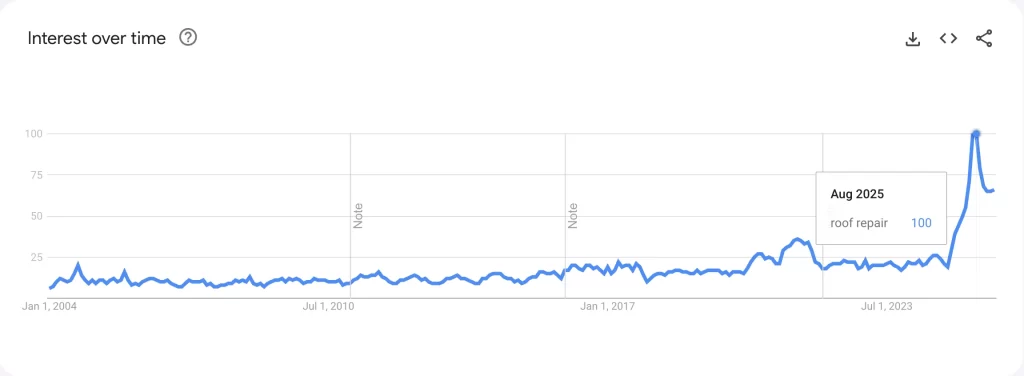
The search term “roof repair” reached the 66th percentile of interest over time in January of 2026. Its highest level of interest ever occurred in August 2025.
Source: Google Trends
17) Women in Roofing
Women make up 5% of the roofing industry’s workforce in 2026. In addition, 11% of roofing machine operators are women.
Source: Fixr
18) Texas Roofing Contractors
There are 8,857 roofing contractors in the State of Texas.
Source: IBIS World
19) Fiberglass Shingles
90% of U.S. asphalt roofs sold are fiberglass shingles.
Source: RoofCalc
20) Residential Roof Square Footage
The average residential roof in the United States is 1,600 square feet.
Source: RoofCalc
21) Tile Roofing Global Industry
Research projects the tile roofing market to reach $41.3 million by 2027.
Source: LinkedIn
22) CAGR Roofing Market Forecast
The USA roofing market is forecasted to grow at a 6.6% CAGR from 2024 to 2032.
Source: Expert Market Research
23) Projected Industry Growth
The roofing industry is projected to increase by 4.3% annually until 2030. The result would be an eight-year consecutive growth rate.
Source: Allied Market Research
24) EPS Insulation Plastic
EPS insulation typically contains about 2% plastic. As a result, roofers should handle the insulation gently, especially when removing it.
Source: Progressive Foam
25) Stormwater Reduction
Between 50 and 60% of rainwater falling onto Pennsylvania green roofs can be recycled back into the atmosphere without entering the stormwater system.
Source: Penn State Extension
26) Asphalt Shingle Market Share
Approximately 75% of North American homes have asphalt shingle roofs, giving the material a 3/4 market share for residential properties.
Source: All Point Construction
27) Global Solar Roofing Market
Projections anticipate that the global solar roofing market will reach 241.6 billion by 2031, partly driven by increasing demand for renewable energy sources.
Source: Cision PR Newswire
28) Florida Roofing Manufacturing Revenue
Florida’s asphalt manufacturing industry is worth $1.5 billion in 2026, growing at a 3.1%. rate since 2020.
Source: IBIS World
29) TPO Membrane Thickness
The vast majority of TPO roof installations utilize 45-mil-thick membranes. The manufacturers’ thickness of these membranes over scrim spans approximately 15 to 19 mils.
Source: Professional Roofing
30) Hail Continues to Damage Roofs
Annual data suggests the U.S. experienced more than 5,373 hailstorms.
As roofing companies know, these storms create roofing jobs quickly and require resources to perform the services as needed.
We expect hailstorms to remain one of the top causes of roofing emergencies in 2026.
Source: Roofer’s Guild
31) Cool Roofs Reduce Energy Demand
Cool roofs can reduce indoor temperatures by 1.2–3.3°C in air-conditioned residential buildings.
Source: Environmental Protection Agency
32) Standing Seam Metal Roof Reflectivity
Standing seam metal roofs can reflect up to 70% of solar radiation while reducing roof surface temperatures by up to 50°F compared to asphalt shingles.
Source: Dependable Roofing

